Structured
Bonds vs NCDs in India: Key Differences, Risks, Returns & Investment Strategy
Explore Bonds vs NCDs in India, key differences, risks, returns, taxation, and investment strategy to help investors choose the right fixed-income option.


In the traditional Indian investment landscape, “safe” has long been synonymous with gold and fixed deposits. However, as inflation gradually erodes real returns, investors are increasingly exploring alternatives that offer both stability and improved yield.
Fixed-income instruments provide a structured way to earn predictable returns with lower volatility than equities, while still allowing for varying risk-return profiles depending on the issuer and structure.
At AFINUE, the focus is on moving beyond conventional allocation, towards intelligently structured income strategies. This brings us to a fundamental question: are Non-Convertible Debentures (NCDs) merely corporate bonds, or do structural nuances significantly influence risk and return outcomes?
Understanding Debt Securities in India
Bonds and debentures play a critical role in capital formation and corporate financing in emerging economies like India. They provide relatively stable income streams compared to equities to investors/ subscribers, while enabling governments and corporations to raise long-term capital.
[1] (Government of India Economic Survey, 2024).
India’s Bond Market Size And Composition
India’s bond market has expanded steadily, driven primarily by government borrowing alongside gradual growth in corporate debt.
Government Securities (G-Secs): ₹105.9 trillion
State Development Loans (SDLs): ₹59.27 trillion
Corporate Bonds: ₹51.58 trillion
Other Instruments: ~₹9.5 trillion
Despite this growth, corporate debt remains underdeveloped relative to global benchmarks, with policymakers such as NITI Aayog and the Ministry of Finance advocating for deeper bond market participation.[2]
Types of Bonds
Government Securities (G-Secs)
Issued by the central, state governments and now, even municipalities, these instruments finance fiscal expenditure and remain the most liquid segment of the market.
State Development Loans (SDLs)
State-issued bonds, auctioned via RBI, primarily fund infrastructure and development projects.
Corporate Bonds
Issued by companies to raise capital, these offer higher yields but carry credit risk linked to issuer strength.
Other Debt Instruments
Includes municipal bonds, infrastructure bonds, and other specialised securities.
Specialised Bond Instruments
Tax-Free Bonds: Interest income is exempt from tax; typically issued by government-backed entities
Municipal Bonds: Used by urban local bodies to fund public infrastructure
Sovereign Green Bonds: Financing environmentally sustainable projects
Sovereign Gold Bonds: Government-issued instruments linked to gold prices, offering fixed interest with capital gains exemption on redemption for individuals
Bonds, Corporate Bonds, and NCDs: The Terminology
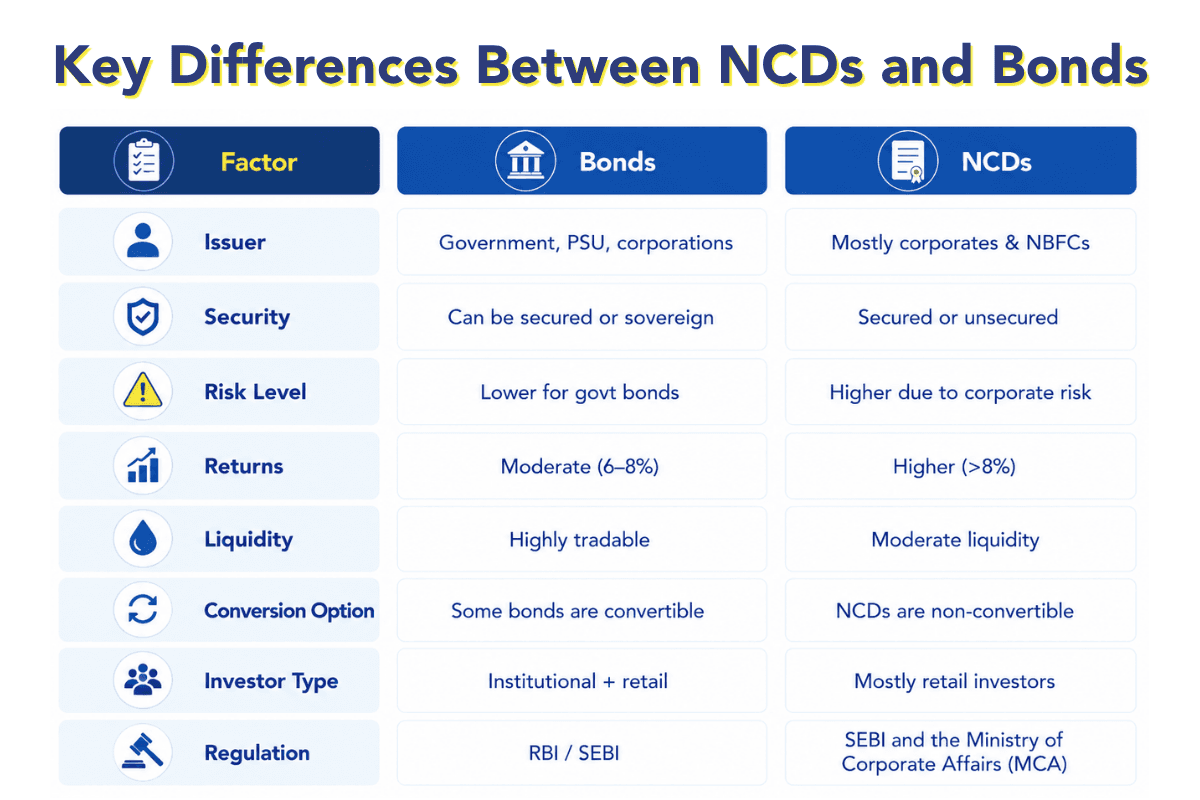
In India, the terms bonds, corporate bonds, and debentures are often used interchangeably, but there are subtle distinctions in structure and usage.
What Are Bonds?
A bond is a fixed-income instrument through which investors lend money to an issuer, typically a government, PSU, or corporation.
Government bonds, in particular, are backed by sovereign credit, making them among the lowest-risk instruments in the domestic market. While not secured by specific assets, they derive strength from the government’s repayment capacity.
Key Features
Fixed or floating coupon payments
Defined maturity period
Tradable in secondary markets (stock exchanges)
Lower credit risk (for sovereign/high-rated issuers)
What Are Non-Convertible Debentures (NCDs)?
These are corporate debt instruments issued by entities such as NBFCs, infrastructure companies, real estate developers and financial institutions to raise capital.
Among retail investors, such instruments have gained popularity due to their relatively higher yields compared to traditional options like bank or post office fixed deposits and government bonds. Increased accessibility via digital platforms and regulatory improvements has further accelerated participation.
From a functional standpoint, these debentures are widely used for:
Lending operations (especially by NBFCs)
Business expansion
Debt refinancing
Infrastructure of construction financing
For investors, the key distinction is this: while all NCDs fall under corporate debt, not all corporate bonds are structured as NCDs.[3]
Types of NCDs in India
Secured NCDs
Backed by tangible or financial assets, like real estate
Trustees have legal rights over pledged collateral
Lower risk within the NCD universe
Unsecured NCDs
No asset charge
Higher yield to compensate for increased risk
Greater dependence on issuer creditworthiness
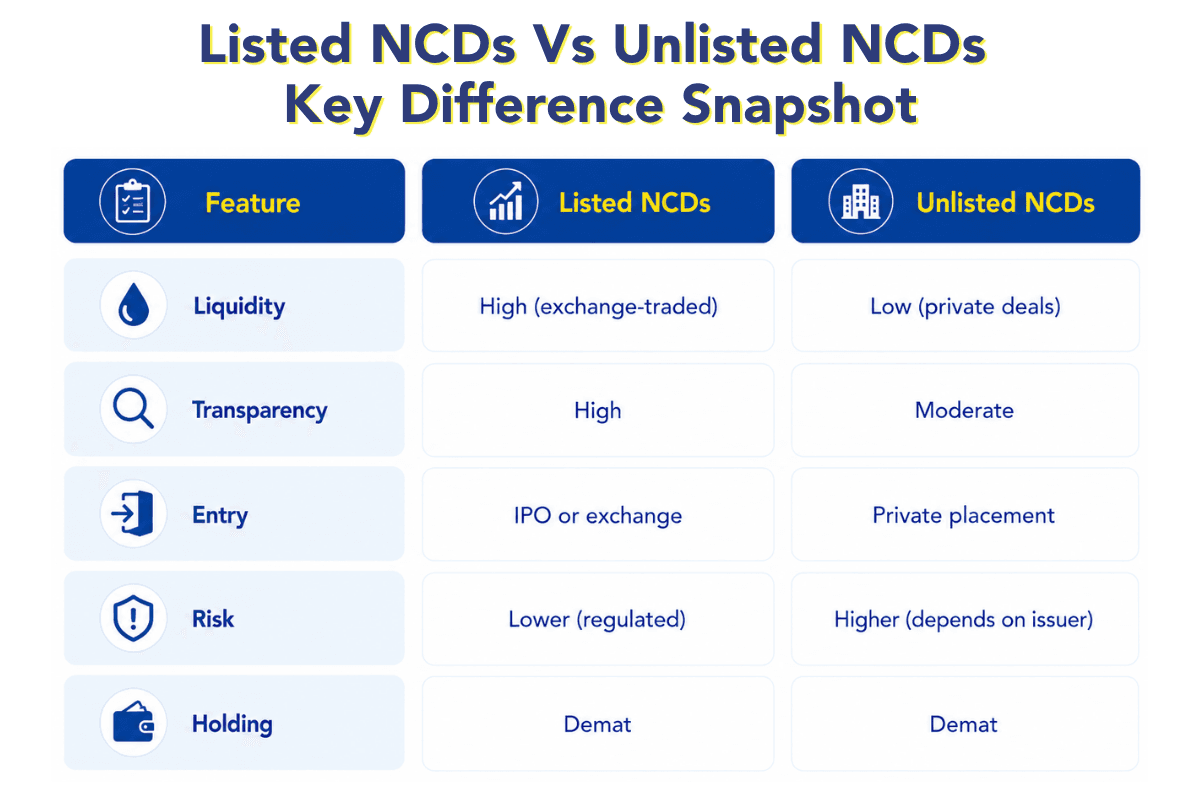
Listed NCDs
Traded on stock exchanges such as NSE and BSE.
Unlisted NCDs
Available only through private placements and lack liquidity, as they are not traded on stock exchanges.
These often carry a higher risk due to limited liquidity and transparency.
Key Risks Investors Must Understand
1. Credit Risk
The biggest risk in NCDs or Corporate Bonds, whether secured or unsecured, is that if the issuing company faces financial trouble, interest and/or principal payments may stop.
Examples in India:
IL&FS crisis
DHFL default
Yes Bank AT1 Bonds
Such events exposed weaknesses in the corporate debt market. This is why issuer quality and security structure matter as much as coupon rate.
2. Interest Rate Risk
Bond prices move opposite to interest rates.
If interest rates rise:
Bond prices fall
Investors may face capital loss in secondary markets.
3. Liquidity Risk
Some NCDs have low trading volume. You may struggle to sell them before maturity.
4. Inflation Risk
If inflation outpaces bond yields, real returns can turn negative, a key risk associated with Government Bonds, which typically offer lower coupon rates.
The above bond yields, real returns become negative. Taxation of Bonds and NCDs in India
Following the Finance Act 2023, the earlier exemption that prevented Tax Deducted at Source (TDS) on interest from listed debentures held in dematerialised form was removed. As a result, interest earned on many corporate bonds and NCDs may now attract TDS under Section 193 of the Income Tax Act, typically at 10% subject to applicable thresholds. This tax provision effectively reduces the IRR on these investments.[7]
Why do NCDs Command a Premium?
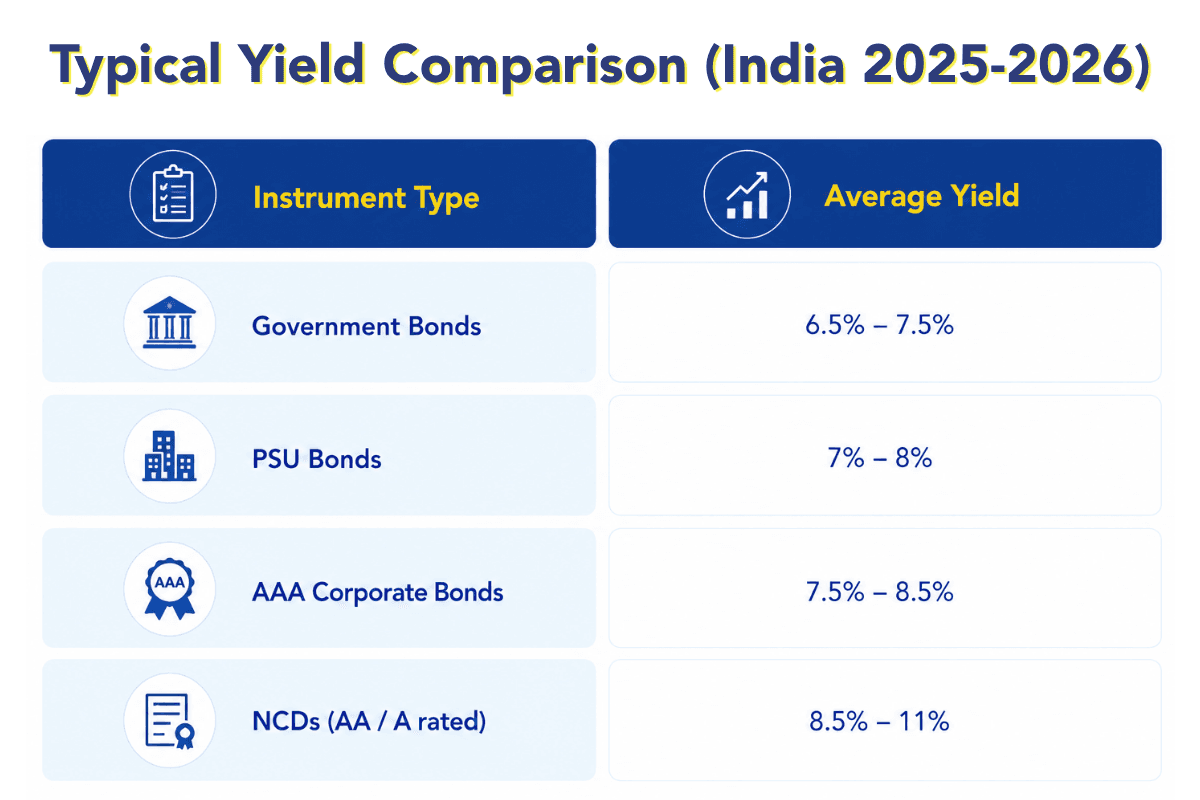
A 10-year Government Bond in India currently yields around 6.5 – 7%, while higher-yielding corporate NCDs issued by NBFCs or mid-tier corporates may offer roughly 9–11%, reflecting the additional credit risk investors assume.[8]
Regulation and Credit Ratings
Government securities are managed by the RBI, while corporate bonds and NCDs fall under SEBI and the Companies Act.
Credit ratings from agencies like CRISIL, ICRA, and CARE provide a benchmark of issuer safety, but are not static.
Example:
DHFL was once rated AAA before defaulting, highlighting the need for continuous monitoring.
Regulatory Oversight under SEBI and the Companies Act
Under SEBI’s Non-Convertible Securities Regulations (2026), issuers need to comply with
Mandatory disclosures
Appointment of debenture trustees
Security cover requirements for secured instruments
Ongoing reporting obligations
These measures enhance transparency and improve investor protection.
The Role of Credit Rating Agencies
Credit ratings play a critical role in corporate debt investing, as they help assess the issuer’s ability to meet its obligations. Instruments are typically rated by agencies such as CRISIL, ICRA, and CARE, with ratings ranging from AAA (highest safety) to D (default).
AAA/AA: High safety, lower interest rates.
A/BBB: Moderate safety, higher interest rates.
However, ratings are not static. Downgrades can significantly impact market value even without a default, which is why investors must track rating changes over time
[10](RBI; [11]SEBI NCS Regulations 2021; [12]Companies Act 2013)
SEBI Listing and Disclosure Regulations for NCDs
The issuance and listing of Non-Convertible Debentures (NCDs) in India are governed by the regulatory framework established by the Securities and Exchange Board of India, primarily under the SEBI (Issue and Listing of Non-Convertible Securities) Regulations, 2021, along with subsequent SEBI master circulars and listing disclosure requirements.
These regulations require issuers to provide comprehensive disclosures regarding financial statements, credit ratings, risk factors, security structure, and the intended use of proceeds before issuing NCDs. Issuers must appoint a debenture trustee to safeguard investor interests and ensure compliance with the debenture trust deed.
For secured NCDs, even if they are unlisted, companies are required to create a charge over specified assets in favour of the trustee and maintain adequate security cover. Additionally, issuers must comply with periodic reporting and disclosure obligations after listing, including updates on financial performance, credit rating changes, and security cover certifications.
Together, these regulatory requirements enhance transparency, strengthen investor protection, and promote accountability in India’s corporate debt market.[13]
2020 Case Study: Yes Bank AT-1 Bond Write-Off
The Yes Bank AT-1 bond crisis of 2020 is one of the most important examples of corporate debt risk in India. It highlighted how certain debt instruments can behave very differently from traditional bonds during financial stress.[14]
Background
Founded in 2004, Yes Bank grew rapidly by lending to large corporate and infrastructure projects. To strengthen its capital base under Basel III norms, the bank issued Additional Tier-1 (AT-1) bonds, which offered higher interest rates than bank deposits and many traditional bonds.
These instruments attracted HNIs, institutions, and retail investors seeking higher yields.
What Makes AT-1 Bonds Different
AT-1 bonds are perpetual capital instruments designed to strengthen a bank’s capital structure. Key characteristics include:
No fixed maturity date
Higher coupon rates
Counted as Tier-1 capital under Basel III
Can be converted to equity or written down during financial stress
Unlike conventional bonds, AT-1 instruments are loss-absorbing, meaning investors carry significantly higher risk.
The Crisis and Write-Off
By 2018–2019, Yes Bank faced rising NPAs, exposure to stressed borrowers, and declining investor confidence.
In March 2020, the Reserve Bank of India placed the bank under a moratorium and implemented a restructuring plan.
As part of this process, ₹8,415 crore of Yes Bank AT-1 bonds were written down to zero, meaning bondholders lost 100% of their investment, while shareholders retained some value after restructuring.
This outcome surprised many investors because bondholders typically rank above equity holders. However, AT-1 bonds are specifically designed under Basel III to absorb losses before other creditors when a bank’s capital falls below regulatory thresholds.
Key Investor Lessons
Not all bonds carry the same risk.
Higher yield usually means higher risk.
Investors must review the prospectus and loss-absorption clauses carefully.
Diversification across issuers and instruments is critical.
For NCD investors, the case reinforces the need to evaluate credit ratings, issuer financial health, and security structure before investing in corporate debt.
To sum up,
The question isn't whether you should choose Bonds over NCDs. A sophisticated portfolio usually has room for both. Bonds provide the "ballast", the heavy weight that keeps the ship steady during a storm. NCDs provide the "sails", the engine that captures the wind of higher yields from debt investments to move your wealth forward.’
As you look to diversify your holdings, traditional fixed deposits may not always deliver adequate real returns in an inflationary environment. Look at the structured world of Bonds and NCDs, or even better, “structured private credit”, with different risk-rewards.
At AFINUE, we are committed to providing research-driven insights that help investors make informed decisions. From Real Estate Financing through NCDs, to Fractional Ownership opportunities is yield generating assets and financing through private credit, our analysis is designed to empower you to build wealth while supporting your lifestyle, your future, and the planet.
BIBLOGRAPHY
[1] (Government of India Economic Survey, 2024).
[2] Jiraff: Indian Bond Market 2025
[3] Economics Times: The rising impact of retail investors on debt capital markets
[4] Bond Market Strategy: How to Profit from RBI Rate Cuts
[5]Reuters: India bond traders seek buybacks as yields climb despite switch
[7] TaxGuru: Exemption from TDS on payment of interest on listed debentures to a resident removed.
[8] Investing.com: India 10-Year Bond Yield
[9] Brick work ratings: Dewan-Housing-Finance-NCD_500Cr
[10] RBI: Government Securities Market in India – A Primer
[11]SEBI NCS Regulations 2021;
[14] The Indian Express: Rs 8,415 cr worth of Yes Bank‘s AT-1 bond written down

Get Our Newsletter
You to create a robust alternate asset portfolio.FAQ’s
It depends on your risk appetite. Government bonds are generally safer with stable returns, while NCDs (Non-Convertible Debentures) often offer higher interest rates but carry higher credit risk since they are issued by companies.
Yes, an NCD is a type of bond. It is a fixed-income debt instrument issued by companies, with the key difference being that it cannot be converted into equity shares.
The biggest disadvantage is credit risk-if the issuing company faces financial trouble, repayment may be delayed or defaulted. Liquidity can also be an issue if you want to exit before maturity.
Warren Buffett suggests keeping a small portion of investments in bonds for stability. His famous strategy recommends 90% in equities and 10% in government bonds for long-term investors.
Yes, billionaires and institutional investors use bonds for capital preservation, diversification, and steady income, especially during market volatility.
Related Insights

What is Private Credit? How It Works, Risks, Returns & Private Credit in India
Discover what private credit (private debt) is, its history, market size, and investment pros & cons. Updated 2026 guide with data, trends and strategies.

Housing 31 Million Students, Will it be a Challenge?
Step into India's evolving world of purpose built student accommodation, where affordable student housing, modern campus living, and innovative investment opportunities redefine smart choices.

Being serious about ‘Horse’-ing around
Horse ownership is not limited to only the ultra-wealthy. Read more on fractional ownership avenues to participate in this equestrian world.

Can you invest in wine - What you need to know
Wine has been an investment asset class for as long as humanity has known to produce it. Unlike Whiskey, where you let it mature for equity gains, wine’s value grows even when stored in bottles, as the vintage and provenance matter in pricing

550% returns in 13 years on a physical asset
Since 2010, gold has given a 200% return and silver 167%. Most people would be happy with those numbers. But imagine making over a 550% return on your investment, while being able to wear and flaunt it!
What is Private Credit? How It Works, Risks, Returns & Private Credit in India
Discover what private credit (private debt) is, its history, market size, and investment pros & cons. Updated 2026 guide with data, trends and strategies.
Housing 31 Million Students, Will it be a Challenge?
Step into India's evolving world of purpose built student accommodation, where affordable student housing, modern campus living, and innovative investment opportunities redefine smart choices.
Being serious about ‘Horse’-ing around
Horse ownership is not limited to only the ultra-wealthy. Read more on fractional ownership avenues to participate in this equestrian world.
Can you invest in wine - What you need to know
Wine has been an investment asset class for as long as humanity has known to produce it. Unlike Whiskey, where you let it mature for equity gains, wine’s value grows even when stored in bottles, as the vintage and provenance matter in pricing
550% returns in 13 years on a physical asset
Since 2010, gold has given a 200% return and silver 167%. Most people would be happy with those numbers. But imagine making over a 550% return on your investment, while being able to wear and flaunt it!