Structured
What is Private Credit? How It Works, Risks, Returns & Private Credit in India
Discover what private credit (private debt) is, its history, market size, and investment pros & cons. Updated 2026 guide with data, trends and strategies.



Private credit (also known as private debt) refers to finance provided to a company or projects by non-banking lenders. These lenders can include high-net-worth individuals (HNIs), Single Family Office (SFO) (serving one family) or Multi-Family Office (MFO) (serving multiple families), institutional investors including sovereign wealth and pension funds, Private Equity offshoots, etc.
Private credit is often described as part of the broader “shadow banking system” operating outside traditional lending channels. Unlike bank loans or publicly traded bonds, private credit transactions are structured and executed outside the public markets. This booming asset class has grown from a niche post-crisis strategy into a multi-trillion-dollar market.
In 2025, the size of the global private credit was $3.5 trillion, and it is estimated to grow to approximately $5 trillion by 2029. Investors (typically pension funds, insurers, SFO/MFO and high‑net‑worth individuals) are drawn to private credit for its potentially higher yields and low correlation with stocks, secondary markets or even bonds.
In this guide, we cover the history of private credit, its market size and trends, common strategies, and what investors should know about due diligence, risks and returns in this complex space.
What is Private Credit and How Does It Work
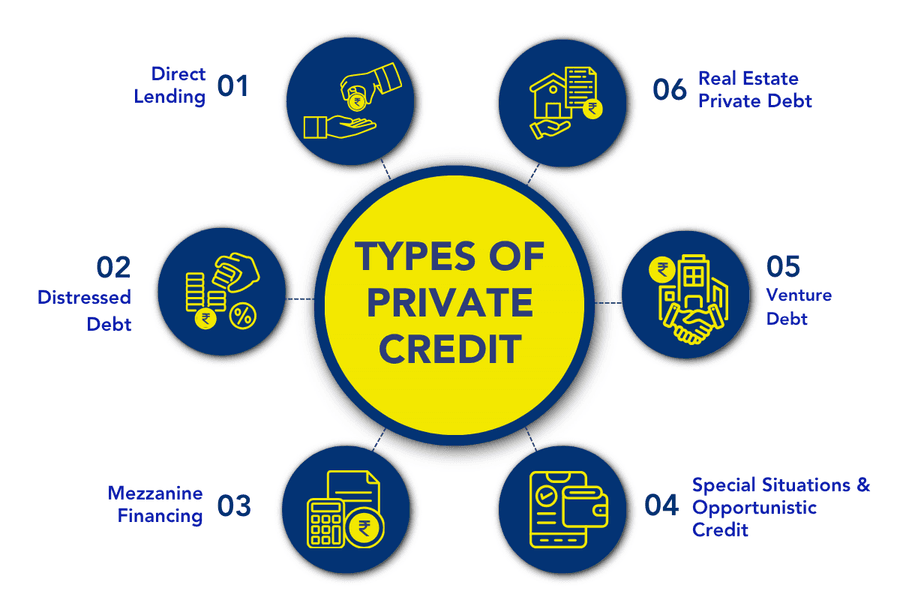
Private credit refers to any loan or financing extended by a non-bank private entity, or even by a public company, without accessing public capital markets, such as bonds or Non-Convertible Debentures (NCDs).
These loan transactions are made directly between a lender and a borrower, or sometimes through a small group of lenders, instead of being bought and sold like stocks. Common types include direct loans to businesses, loans backed by assets, riskier mezzanine loans, loans for stagnant companies, mergers and acquisitions or startups.
Direct Lending: Senior loans to middle‑market companies are often used to finance buyouts or growth. They are usually secured, have floating interest rates, and are sponsored by private equity.
Mezzanine Debt: Subordinated debt (junior to senior loans) sometimes comes with equity warrants. It is riskier but offers higher returns.
Distressed Debt: Loans for troubled firms, or money to buy out existing debt, usually have lower upfront costs. Investors aim to recover value by restructuring the company’s debts and obligations. These loans carry very high risk but can offer high rewards.
Venture Debt: Loans to fast-growing startups (often with warrants) supplement equity financing. They offer flexible terms, higher yields, and provide non-dilutive growth capital to startups.
Asset-Backed Lending: Loans are secured by collateral such as real estate, equipment, consumer credit pools, or even intangible assets like royalties and current or future receivables. These are sometimes called asset-based financing or structured credit.
Private credit deals may have fixed or floating interest rates. Borrowers usually pay a premium for customization and speed. Private credit is also less liquid, meaning investors typically hold it until maturity or refinancing. These deals often include covenants, specific rules on things like additional debt or financial ratios, to protect lenders. In short, private credit combines steady interest payments with tailored terms and higher yields than traditional bank loans or public bonds, making it attractive to high-net-worth individuals and institutions seeking higher returns. [1]
History of Private Credit
Modern institutional Private credit’s roots trace back to the 1970s through the 1980s, the era of junk bonds. Firms like Drexel Burnham Lambert demonstrated that high-yield debt could finance mid-sized companies and leveraged buyouts. However, the modern private credit wave really took off after the 2008 financial crisis. Global banks, hit by losses and stricter regulations (Dodd‑Frank, Basel III), sharply curtailed loans to smaller or non-investment-grade companies. Mid‑market borrowers lost access to traditional funding, creating a financing “gap.” Alternative lenders, private funds, credit managers and hedge funds stepped in to fill this widening gap. [2][3]
Banking Retracement (post‑2008): Tighter capital rules made banks pull back from riskier corporate lending. Private credit funds moved in to lend directly to mid‑sized firms and sponsor-backed deals.
Consolidation of Banks: As big banks merged or focused on large corporations, the small/mid-market was underserved. Private credit found its niche funding middle‑market buyouts, Mergers & Acquisition (M&A) funding, and special situations financing.
Low Interest Rates (2010s): In a prolonged low-interest-rate environment, investors searching for higher yields shifted capital toward alternative assets. Private credit emerged as a compelling option, driving significant fundraising momentum and intensifying competition among private lenders. For example, in 2010, BlackRock had only ~4% of its $3.56 trillion AUM allocated to alternatives (~$140 billion), with no separate allocation to private credit, illustrating how large asset managers were still in the early stages of building exposure to this growing asset class.
Assets have roughly tripled since 2015. By the 2020s, asset managers report a “Golden Age” of private credit. The COVID‑19 shock briefly strained borrowers, but strong underwriting and floating rates have kept defaults relatively low compared to even traditional lending.
These forces mean that private credit has shifted from a niche to a mainstream asset class. “After the GFC in 2008, the associated capital rules for banks, private credit filled a lending void.” Investors and issuers alike now treat it as a core financing channel.[4]
Market Size and Growth
The private credit market has exploded in the last decade.
Capital is increasingly flowing into the asset class from asset managers, pension funds, and even smaller domestic private credit platforms, reflecting growing investor confidence. With strong demand for refinancing, acquisition financing, and capex funding, the opportunity for deploying dry powder remains significant, signalling continued deal activity.[5]
In India, private credit has also expanded rapidly over the past decade. The Indian private credit market is estimated at around $25 billion to $30 billion as of 31st March 2025, in assets under management (AUM). The market has been driven by tightening bank lending norms, demand for flexible corporate financing, and the growing presence of global private credit funds such as Blackstone, KKR, and Ares Management, alongside domestic platforms like Edelweiss Financial Services, 360 Wealth, and Kotak Investment Advisors. As India’s mid-market corporate sector increasingly turns to alternative financing for acquisitions, restructuring, and growth capital, private credit is expected to become a key component of the country’s evolving capital requirements.[6]
Benefits of Private Credit
Investors are attracted to private credit for several reasons:
Higher Yields: Because loans are illiquid and bespoke, private credit typically offers a premium yield. Yields on direct lending often run in the high single digits to low double digits, well above comparable public bonds. A State Street Investment Management (SSGA) analysis note on private credit states that they “may offer higher yields than public credit, due to the customisation premium”. Essentially, borrowers pay extra for certainty and speed, and lenders capture that extra return.[7]
Diversification & Low Correlation: Private credit returns depend on borrower cash flows and collateral values, not daily market swings, thereby ensuring that credit returns have low correlation to equities and traditional bonds. This can dampen volatility in a portfolio. Morgan Stanley notes that private credit can provide diversification benefits beyond public markets (stocks and derivatives) and public market debt instruments (eg, bonds). [8]
Floating Rate Protection: In the Global markets, most private loans float; they adjust with interest rates. In a rising-rate environment (2022–25), this has protected lenders. Over seven rising-rate cycles since 2008, Morgan Stanley found direct lending yields averaged 11.6% (above its norm). Thus, private credit can outperform when bonds lose value.[9]
Income and Capital Protection: Private credit investments generate steady interest income. Many are senior secured loans backed by assets, so in default scenarios, lenders are in front of equity. Studies show loss rates on private credit have been relatively low compared to public credit historically.[9]
Structural Protections: Detailed covenants and monitoring rights give lenders more control. Direct engagement with borrowers can reduce asymmetric information. Investors can tailor covenants to their risk comfort.
Access: Private credit lets lenders participate in financing new age companies directly or through secondaries, mergers or acquisitions (often owned by mid-sized business families or even private equity) that they couldn’t via public debt markets. For institutional investors, it broadens the opportunity set beyond publicly traded debt.
In short, private credit can boost portfolio yield and stability. It often acts as a “plus” to core fixed-income, capturing an illiquidity premium. Professional investors typically allocate around 5–20% of a diversified portfolio to these assets, depending on goals and risk tolerance.
Alternate Investment Funds (AIF) and their role in Private Credit Growth in India
Because private credit is not publicly traded, valuations can be opaque, and investors must often hold positions for long periods. In India, most investments are structured through Alternative Investment Funds (AIFs) regulated by the Securities and Exchange Board of India, particularly Category II AIFs, which commonly invest in private credit, structured debt and special situations.
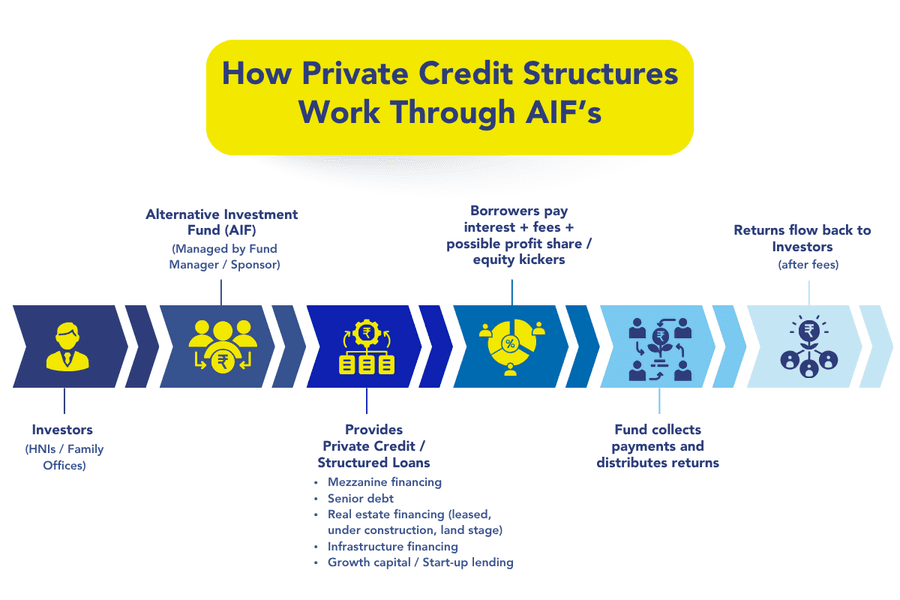
In India, Alternative Investment Funds (AIFs) are regulated investment pools, with investors required to make substantive investments (approximately INR 1 Cr per AIF OR USD 1.07 Mn ). These pooled investment vehicles allow HNIs as well as institutional investors to allocate capital to non-traditional assets such as private debt, real estate, land acquisition financing, bridge and mezzanine debt, distressed asset buy-outs, and structured credit.
Under SEBI regulations, AIFs are divided into three categories.
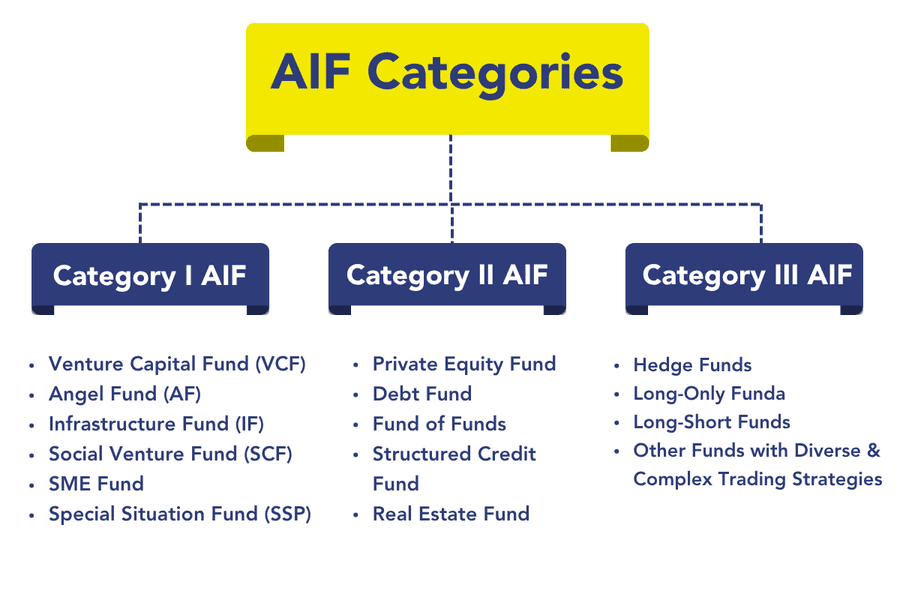
Category II AIFs have become the primary vehicle for private credit strategies in India because they are designed for investments that do not involve excessive leverage but require flexible structuring.
As of 2025, over 1,700 AIFs are registered with SEBI, many of which operate private credit strategies. These funds channel capital from institutional investors and high-net-worth individuals into structured financing for mid-market businesses, real estate projects and venture-backed startups.[10]
How Private Credit Structures Work Through AIF’s
Key Risks in Private Credit Investing
However, investing through such vehicles still involves several risks:
Default Risk: Borrowers in private credit deals are often smaller or non-investment grade. If they can’t pay, investors might lose interest and principal. Experts note that even in good times, some defaults are expected. Recovery values (from collateral) may be uncertain.
Illiquidity: Most private loans cannot be easily sold. Investors’ capital is typically locked up for years, until the loan matures or is refinanced. Secondary markets exist (e.g. private debt secondaries), but are limited. Unlike public bonds, private loans aren’t diversified by thousands of investors trading each day. Exiting positions prematurely can also be costly due to illiquidity discounting.
Concentration Risk: Some funds hold relatively few deals, so a single default can hit the return at the fund level. Checking the diversification and size of a private debt fund’s portfolio should be part of basic due diligence.
Manager and Operational Risk: Success heavily depends on the skill of the fund or asset manager. All investors must ideally and thoroughly vet managers' and GP track records, underwriting processes, and alignment of incentives. Private credit structures have limited regulatory oversight, and that means managers may have more leeway, so transparency and governance matter.
Covenant Quality: While covenants protect lenders, their strength varies. “Covenant-lite” deals (weaker covenants) have appeared in some segments, reducing protections. Investors must read all documents carefully, and exercise similar or more prudence than when investing in public market debt or even an IPO.
Economic and Market Risk: Private credit is not immune to recessions. Pressure on mid-market companies (e.g. during slowdowns or high interest rates) can increase defaults. Liquidity in syndicated and mezzanine markets also dries up in stress, making restructurings harder.
Regulatory and Structural Risks: Private credit is less regulated than banks. While this flexibility is an advantage, future regulations or tax changes could affect private lending. For example, new policies on leverage, reporting, or investor protections might emerge that effectively reduce the attractiveness of current structures.
To mitigate these risks, investors must perform diligent underwriting, which includes analysing the borrower’s cash flows, collateral quality, leverage ratios and management quality. It also means stress-testing deals against economic swings. In general, only accredited investors (investors who are high-net-worth and have demonstrated understanding of complex investments) or institutions should enter this field. As State Street advises, “proper due diligence is needed when lending via private credit”. That includes legal review of loan documents, ongoing monitoring, and contingency planning for liquidity.
How SEBI and RBI Monitor Private Credit in India
Although private credit operates outside traditional bank lending channels, it is not unregulated in India. The sector is primarily supervised by the Securities and Exchange Board of India (SEBI) through the Alternative Investment Fund (AIF) and “Collective Investment Schemes”, while the Reserve Bank of India (RBI) monitors systemic risks related to bank and NBFC participation in these structures. Additionally, special-purpose vehicles, which are corporate entities, can also engage in private credit, although less than 50% of the entity's business income should be lending. These corporate entities, like Pvt Ltd Company or Limited Liability Partnerships, have to comply with RBI, Income Tax and Ministry of Company Affairs (Under Companies Act) regulations, among others, to have part of their operating business focused on Private Credit pure play lending), or structured finance, which could be 100% if engaged in operating businesses, like operating lease or inventory backed financing, here interest is not separately charged by forms part of the price premium in a buy-sell trade.
Key Regulatory Requirements
Minimum Investment Threshold: SEBI requires investors to commit at least ₹1 crore in a Category II AIF scheme (₹25 lakh for employees or directors of the fund). This ensures participation primarily from sophisticated investors such as HNIs, family offices, and institutional investors.
Private Placement Model: AIFs cannot raise money from the general public. Instead, they raise capital via private placement through a Private Placement Memorandum (PPM) that discloses strategy, risks, fees, and governance structures.
Leverage Restrictions: Category II AIFs are generally prohibited from borrowing or leveraging, except for temporary operational requirements, to reduce systemic risk.
Disclosure and Reporting: Fund managers must provide regular disclosures to investors and regulators, including portfolio composition, risk exposures, and valuation practices.
These requirements aim to ensure transparency, governance, and investor protection in private market investments.
RBI Oversight of AIF Investments and Systemic Risk
While SEBI regulates the fund structures, the Reserve Bank of India (RBI) monitors financial institutions such as banks and NBFCs that invest in AIFs.
The RBI has introduced several guidelines to prevent misuse of AIF structures, particularly “evergreening” of loans, where lenders indirectly refinance stressed borrowers through private credit funds.
In December 2023, the RBI restricted banks and NBFCs from investing in AIFs that had downstream exposure to companies already borrowing from lending institutions.
Later guidelines introduced exposure limits for regulated financial institutions investing in AIFs:
A single regulated entity cannot invest more than 10% of the corpus of an AIF scheme
Combined investments from all regulated entities are capped at 20% of the fund corpus
These measures were introduced to limit systemic risks and ensure that private credit vehicles are not used to circumvent banking and lending regulations.
Private credit investments typically involve long-term, illiquid, and complex financial structures. Because of this, regulatory oversight plays a critical role in maintaining financial stability and investor protection.
Together, these frameworks aim to allow private credit markets to grow while ensuring transparency, prudent risk management, and systemic stability in the financial system.
Private Credit in India
The following examples highlight emerging use cases for private credit in India:
Promoter financing: Loans to founders or promoters to increase shareholding or participate in buybacks.
Pre-IPO financing: Structured loans that allow insiders to accumulate equity ahead of public listings.
Flexible lending structures: Private lenders can structure collateralised loans backed by shares rather than traditional corporate assets.
Such strategies illustrate how private credit in India is evolving beyond corporate lending into funding liquidity solutions, structured equity financing, and capital market-linked opportunities.
Special Purpose Vehicles (SPVs) for Asset-Backed Structures
For certain asset-backed transactions, private credit deals may also be executed through Special Purpose Vehicles (SPVs). In these structures, a dedicated entity is created to pool investor capital and finance a specific asset-backed opportunity, ensuring that pure lending, or interest income, is less than 50% of the total income of such an SPV, among other things.
The SPV structures are commonly used in situations where physical asset ownership or transfers are involved.:
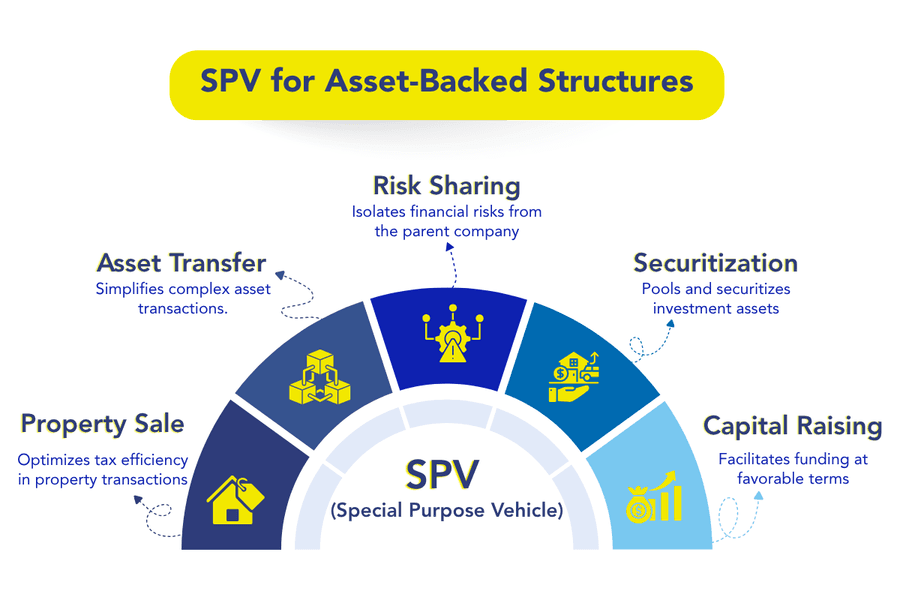
Unlike traditional private credit funds, SPV-based investments are often deal-specific and business-to-business transactions, rather than diversified loan portfolios.
Case Study: High-Profile Private Credit Deals and Pre-IPO Financing
A. Paramount’s bid to acquire Warner Bros.
A real-world example of private credit can be seen in the financing linked to the $108.4 billion takeover attempt of Warner Bros. Jared Kushner’s investment firm Affinity Partners reportedly committed around $200 million as part of the broader funding structure. [11]
Paramount’s acquisition financing included roughly $54 billion in senior bank loans, which form the safest layer of the capital stack in the repayment hierarchy. These loans are prioritised, similar to an avalanche-style repayment approach (repaid first). However, large acquisitions often need additional capital beyond bank lending. This is where private credit investors, Affinity Partners, provided mezzanine financing, a subordinated loan that sits below senior debt but above equity investors.
Because mezzanine lenders take a higher risk, they charge higher interest rates, typically around 12–18% annually, compared with about 7–9% for senior bank debt. The deal would also include custom terms negotiated privately, such as interest spreads over benchmark rates, financial covenants limiting additional borrowing, and, sometimes, equity warrants, which would allow the lender to benefit if the company’s value rises after the acquisition.
In essence, the deal mechanics demonstrate how, in private credit, a non-bank investor privately negotiates a loan, fills a funding gap in a complex acquisition, and earns higher yields in exchange for taking subordinated risk and holding the investment for several years.
Note:Affinity Partners reportedly stepped back from the proposed financing after initial discussions. The case study is presented purely to demonstrate the role private credit investors can play in large leveraged acquisitions.
B. Lenskart Promoter Financing Before IPO
An example of secondary equity purchase financing emerged ahead of the IPO of Lenskart in India.
In 2025, founder and CEO Peyush Bansal increased his personal stake in the company by purchasing 4.26 crore shares worth approximately ₹222 crore from early investors and existing shareholders.
The transaction was financed through private credit rather than traditional bank lending. The funding reportedly came from 360 ONE Prime, a private non-banking finance company that provides structured lending solutions to promoters and high-net-worth borrowers.
The purchase occurred a few months before Lenskart’s planned public listing in 2025, positioning the founder to benefit from potential valuation gains once the company entered public markets.
Beyond the financial upside, such transactions often serve broader strategic purposes. By increasing promoter ownership before an IPO, founders can signal strong confidence in the company’s prospects, which can positively influence investor sentiment during the public offering process.
Private Credit Today (2026 Trends)
Record Fundraising: 2025 saw ~$224 billion globally in new private credit capital raised (3.2 % above 2024). Established managers and new entrants alike are launching private debt funds. Retail/wealth channels are expanding: closed‑end funds and listed Business Development Company (BDCs) (in the U.S.) are democratizing access. [12]
Sector Diversification: In the US, Funds are offering niche strategies beyond the classic M&A lending. Growth areas include asset-based finance, speciality finance (e.g. aviation leasing), and GP (general partner) solutions (including private equity secondary and hybrid credit). In India, AIF’s are providing debt to founders and promoters to participate in share buybacks/ Pre-IPO purchases, as demonstrated by the Lenskart example.
Rising Rates: The high-interest-rate environment of 2022–2025 has made floating-rate private loans very attractive. Lenders can charge higher spreads, and investors get income that moves up with rates. History suggests direct lending has outperformed in rate hikes. As rates gradually ease, yields may compress, but may remain above past norms.
Regulatory Scrutiny: Authorities in the U.S. (SEC) and EU (ESMA, national regulators) are watching private markets more closely. For example, the EU’s new ELTIF regime (European Long-Term Investment Funds) allows wider investor access to private credit under regulation. Meanwhile, US regulators monitor fund leverage and stress in credit vehicles. In India, new rules have made AIF participation only for accredited investors, significantly reducing the overall pool of investors.
Credit Quality: Data indicates some stress in the covenant-lite and leveraged loan segments. Recent reports note a modest rise in companies with interest coverage below 1.0×, though this has improved from 2023 highs. Managers are being overtly selective as we move deeper into 2026.
Continued Growth Forecast: Most analysts expect private credit to keep expanding. Morgan Stanley projects the market growing from ~$3T (2025) to $5T by 2029. Preqin and BlackRock forecasts are similarly optimistic, citing ongoing demand from both investors and borrowers.
In summary, private credit is seen as an evolving while maturing asset class. Its strengths in high-rate, volatile times have been on display. Looking ahead, supply and demand dynamics (refinancings vs. new loans) will determine yield trends. Overall, many believe we are still in a “long bull market” for private credit, albeit with caution on credit quality.
How Investors Participate
Private credit is mainly offered through private funds and specialised vehicles. Here are a few common routes:
Closed-End Funds/Private Credit Funds: Most investors gain exposure by investing in a private debt fund managed by an alternative asset manager. These vehicles pool capital from multiple investors and deploy it according to a predefined investment strategy, without requiring investor approval for every individual loan or disbursal. They typically have lock-up periods (5–10 years) and limited liquidity windows. Fund managers range from large asset managers to boutique credit specialists.
Business Development Companies (BDCs, US only): Publicly traded BDCs are vehicles that lend to small/mid-sized companies. They offer retail investors liquid exposure to private credit strategies, though with fees and regulated constraints.
Collateralised Loan Obligations (CLOs): These are securitisations of private loan portfolios. Some institutional investors buy equity or mezzanine tranches of CLOs focused on middle-market loans.
Liquid Alternatives and ETFs: A few mutual funds and ETFs now hold private loans or related securities. These provide some liquidity but often hold large-cap credit or CLO debt rather than true direct loans.
Direct Co-Lending or Co-Investment: Very large investors (sovereign wealth, endowments, large family offices)) may commit capital directly to senior loans alongside a lead lender.
Structured Finance using SPVs - This is open to individuals as well as institutions, and provides an alternative to pooled vehicles like AIF’s. In these structures, there are no fund managers, and the SPV mostly has either a closed-end strategy or requires shareholders (as against LP’s in a fund) to approve every disbursal or transaction, depending on the structure.
In practice, institutional investors (pension funds, endowments, and insurers) dominate large private credit. For example, one Fed report shows ~31% of private credit fund assets held by pension funds, with insurance and others following. Some family offices and funds of funds also play a role. Retail participation is growing via new fund structures (e.g. UCITS for Europe, 40 Act funds in the US, AIFs and unlisted/un-rated privately placed bonds in India) but remains limited.[13]
To sum up, private credit offers investors a chance to earn higher income and diversify beyond stocks and public bonds. Its history, from the junk bond era to the post‑2008 boom, shows how non‑bank lending fills crucial gaps. But success requires expertise. The best opportunities come from skilled managers who do thorough credit and risk analysis and negotiate strong terms with the right tax-efficient structures. As one expert advises, investors should treat private credit as a strategic complement (not a replacement) to traditional fixed income.
Looking ahead, private credit is likely to remain a key part of many portfolios. Higher yield, sometimes floating rate-exposure, covenant protections and institutional demand all support the case for continued growth. However, it’s vital to remember the risks: lower liquidity, potential defaults, and complexity. Small and retail investors should proceed cautiously, with a focus on simple and transparent structures or vehicles that align with their risk profile.
Looking to diversify beyond traditional assets?
Sign up on Afinue and gain access to deep dives on private credit strategies with real asset-backed structures, high risk-adjusted returns, and exclusive co-investment opportunities.
BIBLOGRAPHY:
Redcliffetraining: https://redcliffetraining.com/blog/sofr-vs-libor#:~:text=LIBOR:%20Available%20for%20various%20maturities,their%20models%20and%20strategies%20accordingly.
Morgan Stanley: https://www.morganstanley.com/ideas/private-credit-outlook-considerations
SEBI: https://www.sebi.gov.in/sebiweb/other/OtherAction.do?doRecognisedFpi=yes&intmId=16

Get Our Newsletter
You to create a robust alternate asset portfolio.FAQ’s
Private credit investing involves lending capital to companies through privately negotiated loans rather than publicly traded bonds.
Private credit can carry risks such as borrower defaults, illiquidity, and valuation opacity, which makes thorough due diligence essential.
Most private credit investments in India are accessed through SEBI-regulated Alternative Investment Funds (AIFs) that typically require a minimum investment of ₹1 crore from accredited investors.
An AIF is managed by a professional fund manager or investment management company, responsible for sourcing investments, conducting due diligence, managing risk, and deploying capital according to the fund’s strategy.
Investors typically participate by committing capital to the fund during its fundraising period. Participation requires completing regulatory documentation, meeting eligibility criteria, and committing the minimum investment amount specified by the fund (often ₹1 crore or more), within pre-agreed timeline.
No. Portfolio Management Services (PMS) primarily invest in publicly listed securities such as equities, debt instruments, and market-linked products on behalf of individual clients. While PMS may include debt investments, it is generally different from private credit funds that lend directly to private companies.
In India, an Accredited Investor is defined by SEBI and typically includes individuals with annual income above ₹2 crore or net worth above ₹7.5 crore, as well as institutions such as banks, mutual funds, insurance companies, and large corporates. Accredited investors may gain access to specialised investment opportunities with different regulatory requirements.
Related Insights

Bonds vs NCDs in India: Key Differences, Risks, Returns & Investment Strategy
Explore Bonds vs NCDs in India, key differences, risks, returns, taxation, and investment strategy to help investors choose the right fixed-income option.

Housing 31 Million Students, Will it be a Challenge?
Step into India's evolving world of purpose built student accommodation, where affordable student housing, modern campus living, and innovative investment opportunities redefine smart choices.

Being serious about ‘Horse’-ing around
Horse ownership is not limited to only the ultra-wealthy. Read more on fractional ownership avenues to participate in this equestrian world.

Can you invest in wine - What you need to know
Wine has been an investment asset class for as long as humanity has known to produce it. Unlike Whiskey, where you let it mature for equity gains, wine’s value grows even when stored in bottles, as the vintage and provenance matter in pricing

550% returns in 13 years on a physical asset
Since 2010, gold has given a 200% return and silver 167%. Most people would be happy with those numbers. But imagine making over a 550% return on your investment, while being able to wear and flaunt it!
Bonds vs NCDs in India: Key Differences, Risks, Returns & Investment Strategy
Explore Bonds vs NCDs in India, key differences, risks, returns, taxation, and investment strategy to help investors choose the right fixed-income option.
Housing 31 Million Students, Will it be a Challenge?
Step into India's evolving world of purpose built student accommodation, where affordable student housing, modern campus living, and innovative investment opportunities redefine smart choices.
Being serious about ‘Horse’-ing around
Horse ownership is not limited to only the ultra-wealthy. Read more on fractional ownership avenues to participate in this equestrian world.
Can you invest in wine - What you need to know
Wine has been an investment asset class for as long as humanity has known to produce it. Unlike Whiskey, where you let it mature for equity gains, wine’s value grows even when stored in bottles, as the vintage and provenance matter in pricing
550% returns in 13 years on a physical asset
Since 2010, gold has given a 200% return and silver 167%. Most people would be happy with those numbers. But imagine making over a 550% return on your investment, while being able to wear and flaunt it!